Monday, March 4, 2013

Rocky Planets


The rocky planets are mostly made up of rock and metal. These planets are very heavy and move slowly. They also do not have rings and very few moons.

ROCKY PLANETS (Mercury - Venus - Earth - Mars )


http://planets.sciencedaily.com/d/c/Rocky

Friday, March 1, 2013

Gas Planets

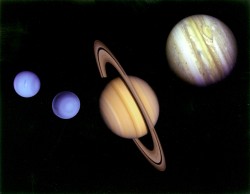
the four gas giants in our Solar System Credit: NASA/JPLGas Planets
  
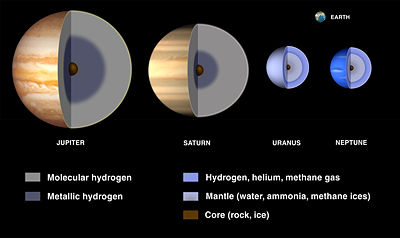
Gas planets are a category of planets without any solid metals or rock. Gas planets are also referred to as gas giants, giant planets, and Jovian planets. Since gas planets do not have a solid surface, you would not be able to walk on them. Gas planets are said to have a rocky center; however, that term is somewhat misleading. Scientists believe that due to the high temperatures and extreme pressures in the center of gas planets their rocky centers are actually liquid metal or rock. Thus, the density of the gas planets simply increases as you go deeper to the center.
There are four gas planets in our Solar System: Jupiter, Saturn, Uranus, and Neptune. The other four planets are known as terrestrial planets. The gas giants in our Solar System are also called the outer planets because they are the four planets in the Solar System furthest from the Sun


Thursday, February 28, 2013

Pluto; a proto planet in transition


Pluto; a proto planet in transition

Pluto is one of thousands of planetesimal sized Trans-Neptunian bodies. For the last few years there has been a raging debate as to whether Pluto is a planet or not. As Pluto is orbit about the sun, it can be considered a planet, except for its diminutive size, which is why it was "demoted". Pluto has a companion, Charon, which one can say is a moon of Pluto. In reality, Charon is another planetesimal which happens to be in orbit around Pluto and shares the same relationship with Pluto. Pluto is caught in a curious two to three resonance with Neptune, which stabilizes its orbit, because it never gets close enough to Neptune to be pulled into or ejected out of the solar system. For every three of Neptune's orbits, Pluto and Charon orbit twice. Pluto belongs to the family of inner Kuiper Belt objects.

Pluto represents the seed of another type of body. It is neither rocky planet nor a gas giant planet. It is made up of volatiles like methane, ammonia, water ice and other hydrocarbons. These molecules were too far out to be collected by the gas giants and their moons. By accretion stages that are identical to those forming the Earth and the other major planets, Pluto, Charon, Sedna and thousands of others are slowly growing in size. They are still under evolution. What remains is competition for material by absorbing smaller planetesimals. Due to their distance from the sun and their as yet weak gravitational influence, their evolution takes billions of year as opposed to the millions it took to form the terrestrial inner planets.
http://syzygyastro.hubpages.com/hub/What-Pluto-Really-Is

Wednesday, February 27, 2013

Classification of the major planets


Definition of Solar System


The Solar System


A solar system consists of a star and all the objects orbiting it as well as all the material in that system. Our Solar System includes the Sun together with the eight planets and their moons as well as all other celestial bodies that orbit the sun.
Besides the sun, 8 planets and their moons, our Solar System contains billions of other objects and extends far beyond the outermost planets. There are several hundred thousand asteroids revolving around the Sun. Most have orbits between Mars and Jupiter. Also, in addition to the more than 800 comets we have recorded passing through the inner part of the solar system, there are billions more lying in the area surrounding the solar system. They are in the disk of debris known as the Kuiper belt and the cloud of comets known as the Oort cloud.

Solar System Info   www.solarserver.com  Find here the latest information about Solar Systems